How Meetings Work in Japanese Companies: The Unwritten Rules
 Lio, Japanese Career Consultant (National license)
Meetings in Japanese companies often feel very different from those in Western workplaces.
For many foreign professionals, the biggest challenge is not the language—but the unspoken rules that shape how meetings actually work.
As a Japanese professional who has observed meetings overseas, I believe that meetings in Japanese companies have a unique cultural structure.
If you attend a meeting without understanding this context, it can easily lead to misunderstandings.
I have summarized the key points below, so please take a look.
Understanding these unwritten rules will help you avoid misunderstandings, read the room correctly, and build trust in Japanese workplaces.
Lio Author
Representative at BANSO Works
I am a Tokyo-born Japanese professional writer with a bachelor’s degree in intercultural communication, and I have lived in five countries.
I am also a nationally certified Career Consultant in Japan, with practical expertise in behavioral psychology.
In addition, I have hands-on HR experience at four major Japanese companies.
This combination of academic training in intercultural communication and extensive professional experience allows me to provide practical, experience-based insights into Japanese workplace culture.
1. Meetings Are for Confirmation, Not Decision-Making
One of the biggest surprises for foreign employees is that important decisions are rarely made in the meeting itself.
In Japanese companies, meetings often exist to:
- Confirm decisions already discussed informally
- Share information across departments
- Create alignment and consensus
By the time a proposal appears in a meeting, the outcome is often already decided through prior conversations (known as nemawashi).
Tip:
If you want to influence a decision, talk to key stakeholders before the meeting(we call this "Nemawashi", not during it.
2. Silence Is Not Disagreement
In many Western cultures, silence suggests confusion or opposition.
In Japanese meetings, silence usually means:
- Careful listening
- Respect for hierarchy
- Internal consideration
People may stay silent even when they have concerns—especially if senior staff are present.
Tip:
Do not rush to fill silence. Pausing shows emotional intelligence and cultural awareness in Japan.
You may also want to read:
Silence in Japanese Meetings: What It Really Means at Work
Silence in Japanese offices often confuses foreign professionals.In meetings, discussions may suddenly stop. A manager asks, “Any opinions?” — and the room goe…
 Banso Works, Japan for Global workers
3. Speaking Order Follows Hierarchy
Who speaks first in a Japanese meeting is rarely random.
Typically:
- The most senior person speaks last
- Junior members wait to be invited to comment
- Open debate is rare in formal meetings
Directly challenging a senior person in front of others can be seen as disruptive rather than constructive.
Tip:
If you disagree, raise concerns privately after the meeting or through your direct manager.
4. Preparation Matters More Than Performance
Japanese meetings value preparation over spontaneous discussion.
It is common that:
- Documents are shared in advance
- Participants are expected to read thoroughly beforehand
- Questions during meetings are minimal
Asking basic questions in the meeting may signal a lack of preparation.
Tip:
Read all materials carefully and prepare clarifying questions for informal follow-ups instead.
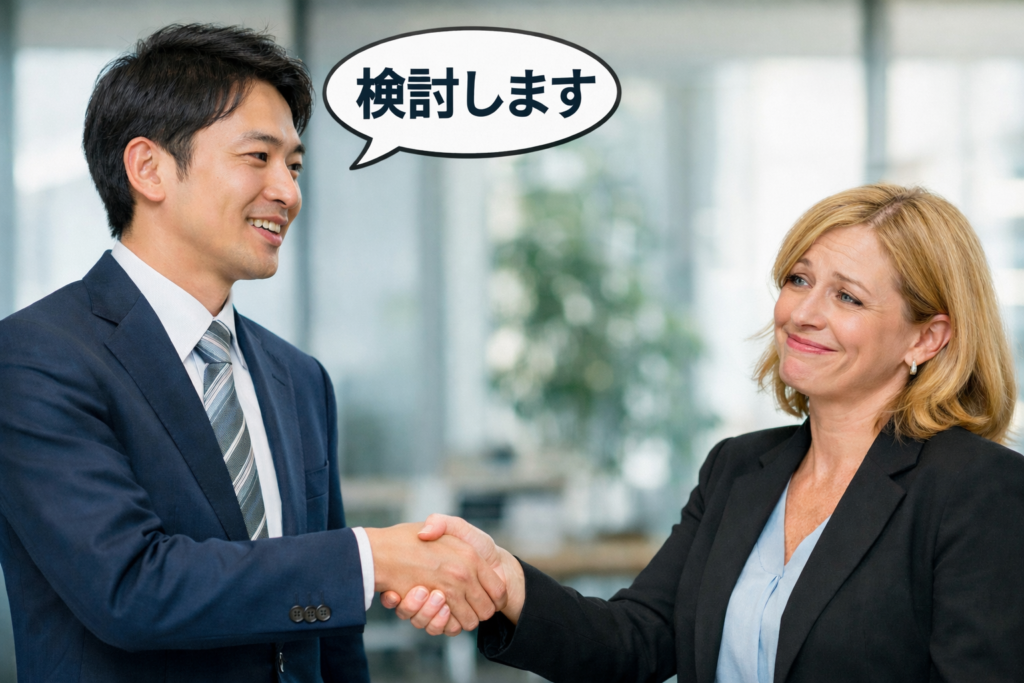
5. “We’ll Think About It” Often Means “No”
One of the most misunderstood phrases in Japanese meetings is:
“We’ll think about it.”
In many cases, this politely means:
- “This will be difficult”
- “We are not moving forward”
- “No, but we don’t want to say it directly”
Direct refusals are often avoided to maintain harmony (wa).
Tip:
Listen to tone, context, and follow-up actions—not just words.
You may also want to read:
What Does “We’ll Think About It” (検討します)Really Mean in Japanese Business?
If you’ve ever worked with Japanese colleagues or clients, you’ve probably heard the phrase “検討します” (kentou shimasu), which literally means “We’ll think a…
6. Meetings Are About Relationship-Building
Beyond efficiency, meetings serve a social purpose:
- Reinforcing group harmony
- Showing respect and alignment
- Maintaining long-term trust
This is why meetings may feel slow or indirect to foreigners—but they play an important role in Japanese organizational culture.
Final Thoughts: Adapting Without Losing Yourself
You do not need to abandon your own communication style to succeed in Japan.
However, understanding how meetings actually function beneath the surface will help you navigate Japanese companies more smoothly and reduce unnecessary frustration.
Cultural literacy is a career skill—especially in Japan.