What Does “We’ll Think About It” (検討します)Really Mean in Japanese Business?
 Lio, Japanese Career Consultant (National license)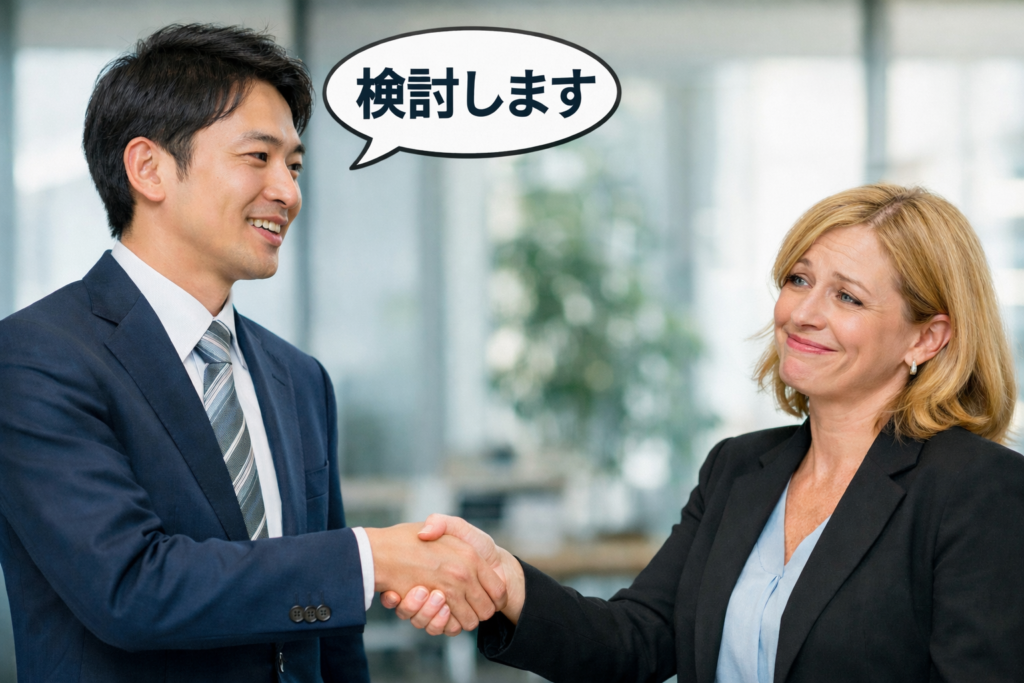
If you’ve ever worked with Japanese colleagues or clients, you’ve probably heard the phrase “検討します” (kentou shimasu), which literally means “We’ll think about it” or “We will consider it.” At first glance, this seems like a polite, noncommittal way to respond. But in Japanese business culture, it carries subtle, context-dependent meanings that can be confusing for foreigners.
As a Japanese native with experience observing both local and international work environments, I’ve noticed that “We’ll think about it” is used frequently even among Japanese colleagues. It’s part of the high-context, implicit communication style in Japan—something that often leaves non-Japanese professionals unsure of the true intention behind the words.

Lio Author
Representative at BANSO Works
I am a Tokyo-born Japanese professional writer with a bachelor’s degree in intercultural communication, and I have lived in five countries.
I am also a nationally certified Career Consultant in Japan, with practical expertise in behavioral psychology.
In addition, I have hands-on HR experience at four major Japanese companies.
This combination of academic training in intercultural communication and extensive professional experience allows me to provide practical, experience-based insights into Japanese workplace culture.
Two Patterns of “We’ll Think About It”(けんとうします)
From my native Japanese observations, there are two main patterns when this phrase is used in business:
1. When a Decision-Maker Says It
If the person who responds has the authority to make a decision—usually someone at the department head level or above—then “We’ll think about it” usually means:
- The idea has a low chance of approval (roughly 20% in my view).
- The decision-maker is being polite while signaling that they will confirm internally before giving a final answer.
- This reflects Japan’s group decision-making style, where even the person with authority may consult superiors or other stakeholders before confirming a decision.
In short, it’s a polite “no,” but framed as a process to avoid direct confrontation.
2. When a Non-Decision-Maker Says It
If the responder does not have decision-making authority (often at the manager or section chief level), the phrase usually indicates:
- They cannot make the final decision on the spot.
- The outcome is genuinely uncertain at the time of discussion.
- You can roughly assume a 50% chance of approval, as the request will still need review by the actual decision-makers.
Foreign professionals often find this difficult to navigate because it’s hard to know who really holds the decision power in a Japanese company. In practice, department heads (部長) and above are usually the final decision-makers, while managers and section chiefs are often just intermediaries.
Why It’s Hard for Foreigners
Japanese communication is often high-context, meaning that much of the meaning is implied rather than stated outright. Unlike the low-context style common in Western business, where “yes” or “no” is typically explicit:
- “We’ll think about it” is rarely a definitive yes.
- It can range from a polite decline to a genuine pending decision.
- Understanding the likelihood of approval requires reading the speaker’s position and context, which is something AI and cultural analysis can help clarify, but still requires human judgment.
An AI Perspective
From an AI standpoint, phrases like “We’ll think about it” illustrate the importance of contextual signals in language understanding:
- Positional data: Knowing the speaker’s role in the organization helps predict the outcome.
- Probability estimation: AI models can assign approximate probabilities based on patterns of usage. For example, decision-makers saying “we’ll think about it” → ~20% approval; non-decision-makers → ~50%.
- Cultural context embedding: To interpret Japanese business language accurately, AI must integrate social hierarchy, group decision-making norms, and communication indirectness.
For foreigners working in Japan, this analysis can be a valuable guide for managing expectations and planning follow-ups.
Practical Tips
- Identify the decision-maker: If the person you are speaking with is below department head level, expect further review.
- Follow up politely: A gentle follow-up after a week or two is acceptable, but avoid pressing too hard—Japanese business culture values patience and respect.
- Read between the lines: “We’ll think about it” often signals a polite decline or a pending review. Understanding the context helps avoid misunderstandings.
Bottom Line
In Japanese business, “We’ll think about it” is not a straightforward yes or no. Its meaning depends heavily on the speaker’s role and the company’s decision-making culture. By combining cultural knowledge with careful observation, foreign professionals can navigate these subtle cues more effectively—and avoid unnecessary confusion.